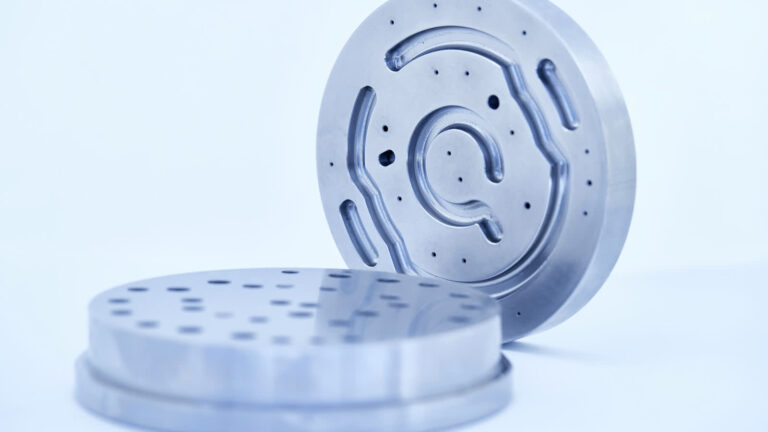
Tools with conformal cooling

Home/Vacuum brazing
In vacuum brazing, we join your components made of similar or dissimilar materials using a suitable brazing filler metal. Thanks to the vacuum atmosphere, no flux is needed for brazing and the component surfaces remain oxide-free.
The process is particularly suitable for components with complex geometries, for joining assemblies with numerous joints and for combinations of different materials. Large and heavy components can also be joined.
In our vacuum furnaces, we braze unalloyed steel, stainless steel, copper and cemented carbide (tungsten carbide), among other materials. The joints offer high strength and corrosion resistance, and the component surfaces are clean and oxide-free after brazing. Controllable, uniform heating of the entire assembly produces low-stress joints with high dimensional accuracy in reproducible quality.
Ideally, we support you in your projects from the design phase, through sample production, right up to the series part.
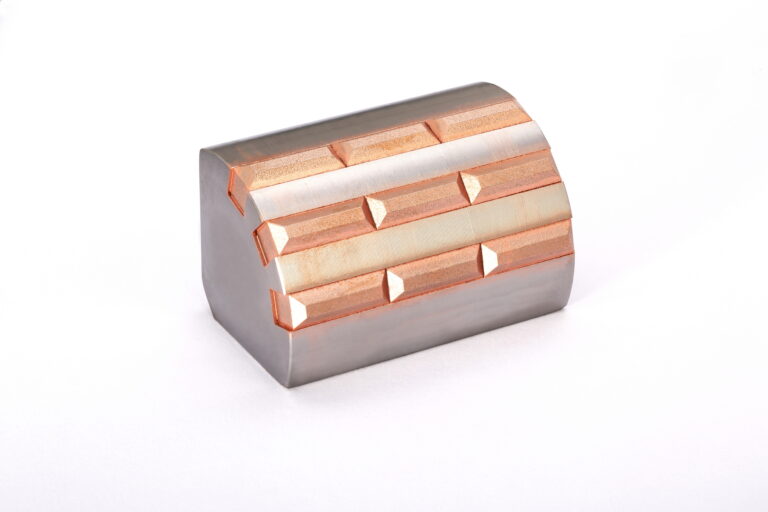

A major advantage of brazing technology is the ability to join a wide variety of materials and material combinations. The overview shows what is frequently used. We check special materials for brazeability.
1.4301
1.4401
1.4571
1.4016
1.4112
1.0038 (S235JR)
1.0045 (S355JR)
1.0503 (C45)
1.0308 (C15)
1.0402 (C22)
2.0040 → Cu-OF (CW008A)
2.0046 → Cu-OFE (CW009A)
2.0044 → Cu-HCP (CW021A)
2.0047 → Cu-PHC (CW022A)
WC-TiC-Co
WC-TaC-Co
WC-NbC-Co
TiC-NiMo
Aluminium oxide (Al₂O₃)
Zirconium oxide (ZrO₂)
Silicon carbide (SiC)
Silicon nitride (Si₃N₄)
Boron nitride (cBN)
1.2343 → X37CrMoV5-1
1.2344 → X40CrMoV5-1
1.2083 → X40Cr14
1.2367 → X38CrMoV5-3
1.2379 → X153CrMoV12
Selection of manufacturer-specific steels:
Elmax, Tyrax, Stavax, Orvar Supreme, Mirrax (Uddeholm)
K340, K360, M333, M340, W360 (Böhler)
Fastcool 50 (STM)
The filler metal is selected according to the base materials and the required component properties. Depending on the application, we use filler metals in the form of paste, powder, foil or wire preforms. Discover our most commonly used filler metals at a glance.
Filler metals according to DIN EN ISO 17672:
Cu 102 (Cu100 / Tm 1,083°C)
Cu 110 (Cu100 / Tm 1,083°C)
Cu 141 (Cu100(P), P max. 0.075% / Tm 1,083°C)
Filler metals according to DIN EN ISO 17672:
Ni 620 (Ni82CrSiBFe / Tm 970-1,000°C)
Ni 631 (Ni95SiB / Tm 980-1,070°C)
Ni 650 (Ni71CrSi / Tm 1,080-1,135°C)
Ni 700 (Ni89P / Tm 870°C)
Ni 710 (Ni76CrP / Tm 890°C)
Ni 740 (Ni60CrPSi / Tm 980-1,030°C)
Filler metal according to DIN EN ISO 17672:
Ag 272 (Ag72Cu / Tm 780°C)
Filler metal according to ISO 3677:
B-Ag64CuInMnNi (Tm 730 -780°C)
Three-layer filler metal 64/Cu
B-Ag64CuInMnNi (Tm 730 – 780 °C)
Silver filler metal Ag/Cu/Ag with a Cu interlayer to reduce stress. It is mainly used for brazing cemented carbides.
One of the 5 available systems is sure to be the right one for your task.
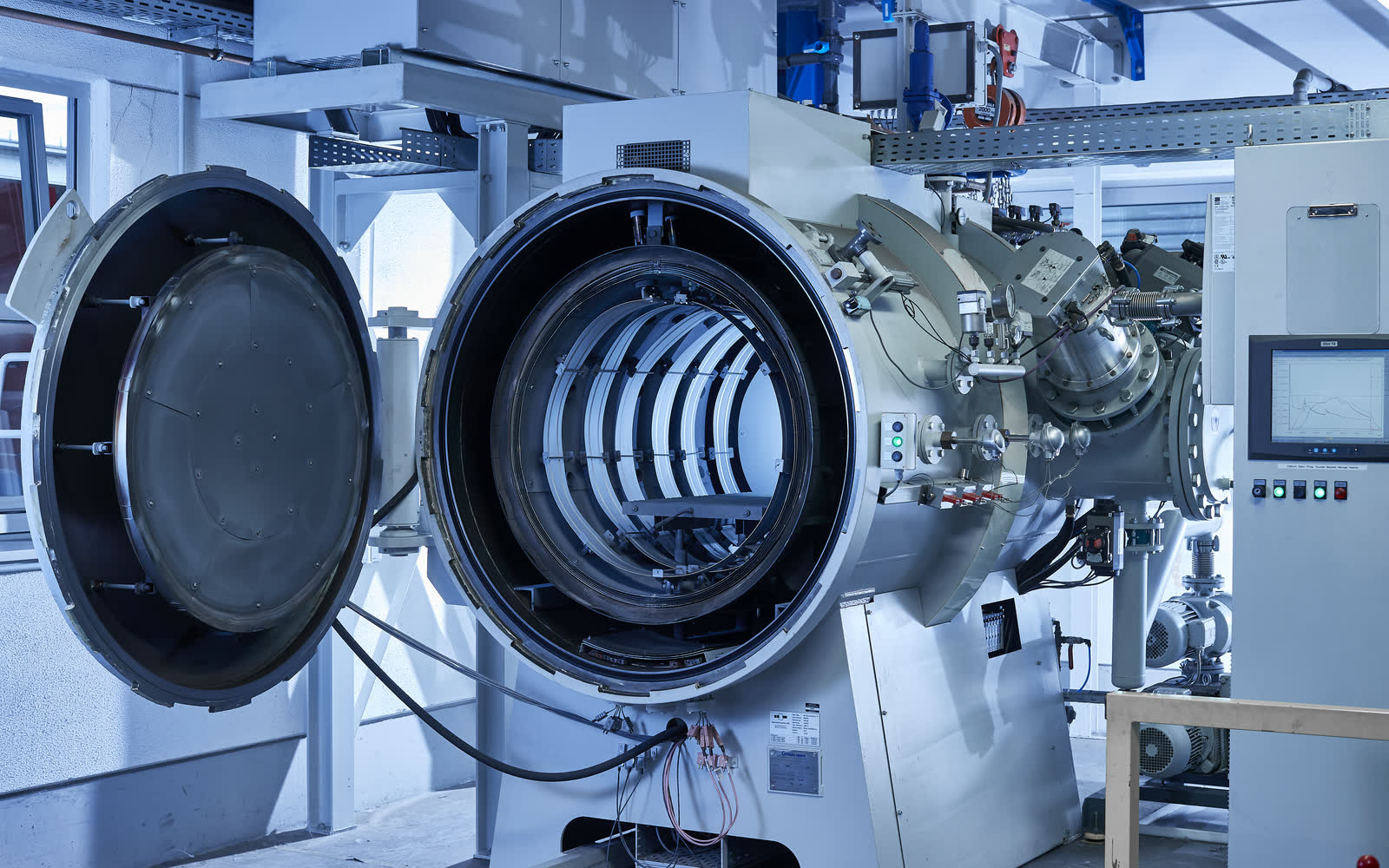
Our vacuum furnaces differ not only in the size of their usable heating chambers but also in the vacuum they can achieve. We can braze your components in medium vacuum or high vacuum, depending on the base materials and filler metals used. If your components are to be hardened directly after brazing, that is no problem either. We have furnaces that allow rapid cooling with a quenching pressure of up to 5 bar. In addition to nitrogen, argon or Varigon can also be used as the cooling gas.
We are not put off by large components either.
Our largest furnace has a chamber size of 2,000 mm x 900 mm x 900 mm, and the components can weigh up to approx. 1,300 kg. For very high-alloy components, we have a vacuum furnace with an all-metal lining (molybdenum). Among other things, it can also join ceramics to each other in high vacuum.
Brazing in a vacuum furnace takes place in an almost oxygen-free environment, which prevents additional surface oxidation.
Optimum wetting conditions produce durable, stable brazed joints with mechanical properties close to those of the base material.
The control technology used achieves very uniform and reproducible results, raising the quality and reliability of the components to a high level. Individually adapted temperature–time cycles make it possible to combine brazing with quenching and tempering of the material.
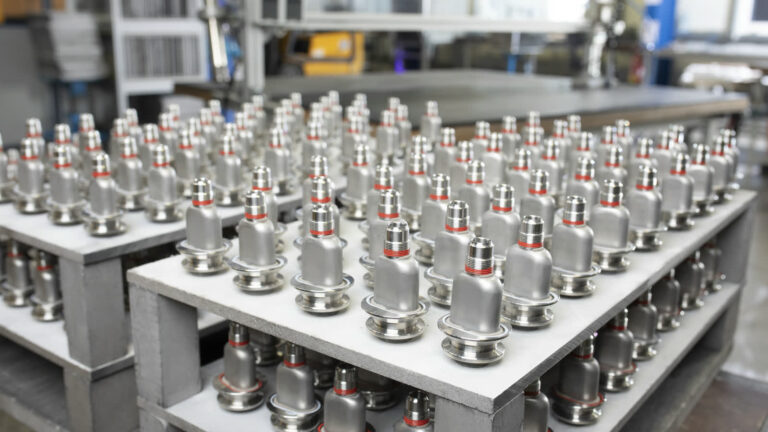
Furnace chambers of different sizes allow brazing of anything from single parts to series batch sizes in a single “furnace run”.
In addition to its process advantages, vacuum brazing therefore also offers economically attractive conditions for efficient and competitive series production.
This is made possible not only by modern equipment but also by qualified and motivated employees who bring their many years of experience to the preparation of the components.
Only such a combination leads to the desired and promised results.
We are a service-oriented company with a high level of technical advisory expertise, and we are easy to reach.
We stand for cooperative and transparent communication with our customers. Short response times and well-founded technical dialogue ensure efficient, solution-oriented collaboration on an equal footing.
Our quotations are clearly structured, precise in content and consistently tailored to your specific task.
For a high-quality brazed joint, defined technical requirements such as joint clearance, insertion depth and surface condition must be met. We safeguard these parameters in close consultation with you.
We provide comprehensive support with component design as early as the design phase. This ensures that all brazing requirements are met and that open questions are clarified at an early stage.
Defined brazing processes, reproducible furnace programmes and clearly documented work instructions and production specifications form the basis for consistently high-quality, repeatable brazing results.
We also take a holistic view of downstream process steps. From fixtures for the precise pre-joining of components to well-thought-out solutions for leak testing.
Marking, process certificates and in-process quality controls can also be provided.
No. Vacuum brazing is flux-free. The vacuum and physical processes ensure that the filler metal wets the component surfaces even without flux. The components leave the furnace with bright metallic surfaces, so no subsequent cleaning is required.
In principle, a wide variety of base material combinations is possible. Combinations of unalloyed steel, stainless steel, copper, cemented carbide and technical ceramics are possible. Because the mechanical properties sometimes differ greatly, the desired combination must be examined closely on a case-by-case basis.
Materials whose alloying elements evaporate easily under vacuum, e.g. zinc and manganese, are excluded.
Yes, this is a special feature of brazing and especially of vacuum brazing. Dissimilar joints can be produced reliably by selecting a suitable filler metal. Cemented carbide/steel combinations are also used very frequently. They are found in many branches of industry.
Call us directly
+49 2373 9772-30or
We’ll call you back
Within one working day.
Thank you! We’ll get back to you within one working day.