Brazing of special contours

Home/Induction brazing
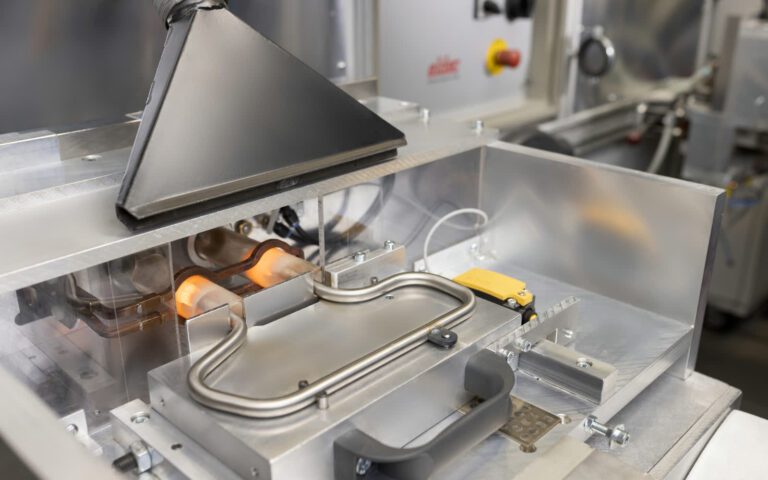
Induction brazing refers to the joining process of brazing in which the heat is introduced into the components to be joined by induction. The distinctive feature of induction brazing is very rapid, easily controllable heating that is confined to a localised area.
The rapid heating is achieved by generating a magnetic field in the joint area. This magnetic field causes the atoms in the base material to oscillate, which heats it up.
With induction brazing, too, oxidation of the brazed joint by atmospheric oxygen must be prevented. For this purpose, the brazing area is enclosed in a chamber or quartz tube and purged with nitrogen or forming gas.
For a wide range of common materials, this approach makes it possible to do without flux. The components remain bright, show no temper colours and therefore do not need to be cleaned after induction brazing.
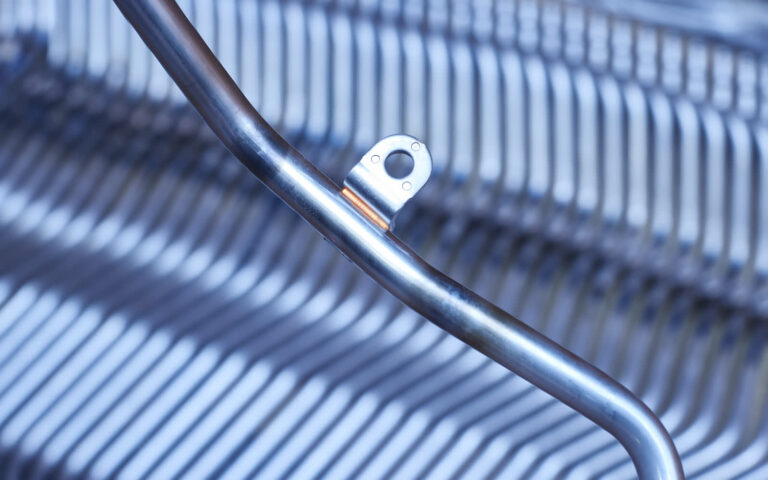
A major advantage of brazing technology is the ability to join a wide variety of materials and material combinations.
1.4301
1.4401
1.4571
1.4016
1.4112
1.0038 (S235JR)
1.0045 (S355JR)
1.0503 (C45)
1.0308 (C15)
1.0402 (C22)
The filler metal is selected according to the base materials and the required component properties. For induction brazing, we mainly use filler metal in the form of wire preforms. Discover our most commonly used filler metals at a glance.
Filler metals according to DIN EN ISO 17672:
Cu 102 (Cu100 / Tm 1,083°C)
Cu 110 (Cu100 / Tm 1,083°C)
Cu 141 (Cu100(P), P max. 0.075% / Tm 1,083°C)
Filler metal according to DIN EN ISO 17672:
Ag 272 (Ag72Cu / Tm 780°C)
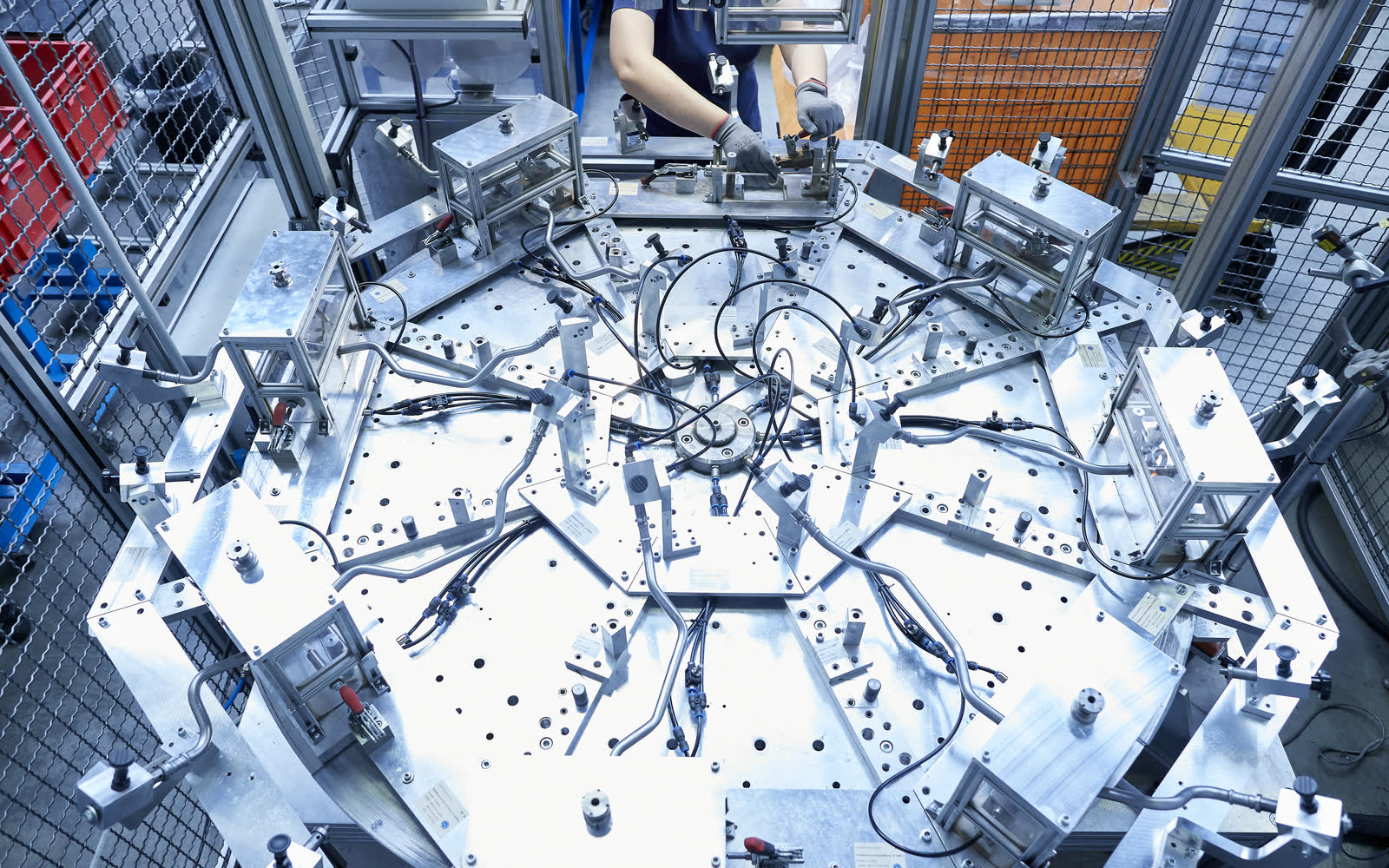
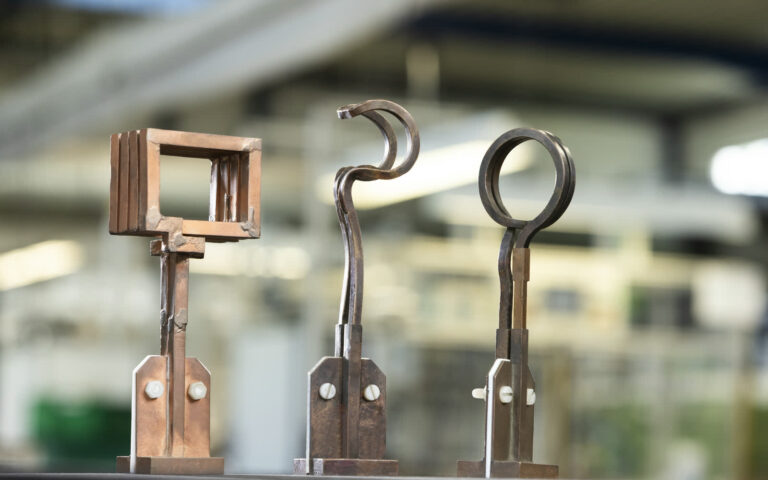
Four induction systems round off our portfolio. For your brazing task, three rotary indexing tables with eight stations are available. The actual brazing takes place at one station under a bell with a protective atmosphere. At the other seven stations, the components are cooled to the point where no oxidation can occur when they are removed. These systems also make it possible to braze particularly long components (tubes) of up to 3,000 mm. We adapt the required inductors individually to ensure rapid, targeted heating.
A further system with two chambers, used alternately, also makes it possible to braze components with more complex geometries. Here, too, brazing is possible without the additional use of flux.
Induction brazing enables rapid, locally confined heating, so that only the joining zone is subjected to thermal load. Thanks to minimal heat-affected zones, virtually distortion-free components can be produced, even with complex geometries. This technology is characterised by very short heating phases and high process speed.
Thanks to precise controllability, reproducible brazed joints of consistently high quality are produced. The process can also be automated to a high degree. Last but not least, the direct energy input ensures energy-efficient and economical process control.
We are a service-oriented company with a high level of technical advisory expertise, and we are easy to reach.
We stand for cooperative and transparent communication with our customers. Short response times and well-founded technical dialogue ensure efficient, solution-oriented collaboration on an equal footing.
Our quotations are clearly structured, precise in content and consistently tailored to your specific task.
A high-quality brazed joint requires compliance with defined technical requirements such as joint clearance, insertion depth and surface condition. We validate these details in close consultation with you.
We provide comprehensive support with component design as early as the design phase. This ensures that all brazing requirements are met and that open questions are clarified at an early stage.
Defined processes, reproducible brazing parameters and clearly documented work instructions and production specifications form the basis for consistently high-quality, repeatable brazing results.
We also take a holistic view of downstream process steps. From fixtures for the precise pre-joining of components to well-thought-out solutions for leak testing.
Marking, process certificates and in-process quality controls can also be provided.
Unlike furnace brazing, induction brazing does not heat the entire component, but only the area around the brazed joint. This reduces thermal distortion of the component as a whole to a minimum.
To prevent oxides, the area of the brazed joint is purged with nitrogen or forming gas.
Depending on the alloying constituents, the use of a flux may become necessary.
Yes, induction brazing is a standard process in the manufacture of saw blades, for example. However, other cemented carbide components can also be joined using the induction brazing process. In many cases, cemented carbide has a lower coefficient of thermal expansion than the parts it is joined to. This is where rapid, localised heating shows its advantages.
In a great many cases, induction brazing works without flux. To prevent oxides, the area of the brazed joint is purged with nitrogen or forming gas. The base materials to be joined are the decisive factor. Depending on the alloying constituents, the use of a flux may become necessary.
Call us directly
+49 2373 9772-30or
We’ll call you back
Within one working day.
Thank you! We’ll get back to you within one working day.